
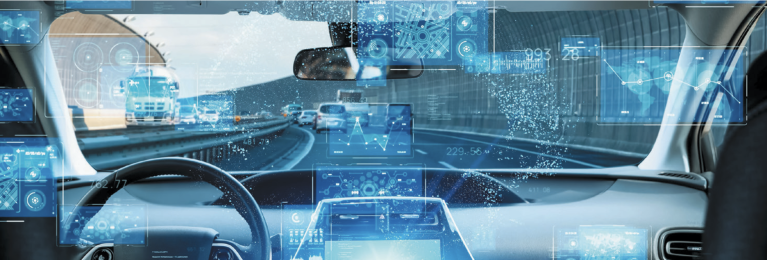
Indeed, autonomous driving remains a major technological and scientific challenge, at the intersection of artificial intelligence, robotics and road safety. For over a decade, two main approaches have dominated: on the one hand, reinforcement learning in simulation, where agents explore virtual environments such as CARLA (an open-source benchmark model) to learn how to navigate using reward signals; on the other, imitation of human experts, where models learn to replicate the decisions of real drivers using large annotated databases. These strategies have led to considerable progress, but they face two major obstacles. Firstly, simulators struggle to capture the full richness and diversity of the real world, making the transition from simulation to the road extremely difficult. Secondly, imitation-based approaches require costly annotated data: thousands of hours of driving are needed, enriched with HD maps, GPS trajectories and object detections. However, even with these efforts, certain rare but critical situations — a pedestrian darting between two cars, a car driving the wrong way, a sudden obstacle — remain very under-represented in the datasets. The project to be presented here offers an alternative: capitalising on available data and learning to drive from videos sourced from YouTube.
The Valeo AI teams utilised 220,000 hours on the NVIDIA H100 GPUs of the Jean Zay supercomputer to carry out this innovative project. These resources were allocated to the project as part of the “Grands Challenges” programme running in 2025 on this supercomputer, which was acquired by GENCI from Bull and is hosted and operated by IDRIS (CNRS).
Alexandre Boulch (Valeo.ai) and Elias Ramzi (Valeo.ai) will present this project during the webinar taking place on 20 May, from 3.30 pm to 4.30 pm.
To register: https://www.eventbrite.fr/e/grands-challenges-jean-zay-4-la-conduite-au…
Dernière modification le 18 May 2026