
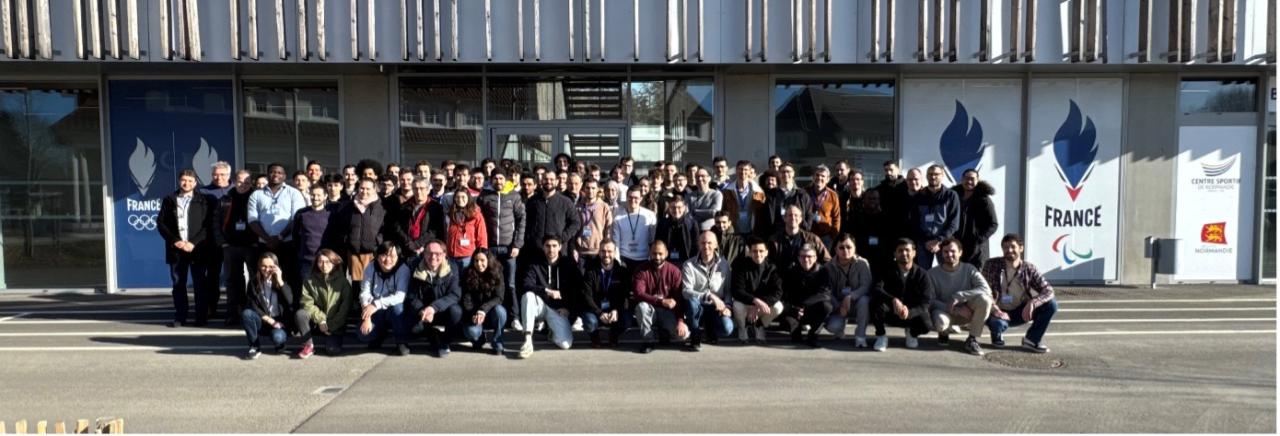
Figure 1: Group photo of all ECFD9 participants.
For a week, eleven of its research engineers, had the opportunity to put the Board on the map by presenting ONERA projects and taking part in plenary sessions, hackathons and workshops.
5 flagship projects were presented by ONERA at the event.
- The "Intelligent Zoom" on flows (Mesh Adaptation)
Automatic mesh adaptation is taking on an increasingly prominent role in numerical simulation. It involves identifying critical areas and improving accuracy only where necessary, thus reducing overall cost. Today, this technology is used on many applications: civil aircraft, wind tunnels and hypersonic craft, and the work carried out will enable this technology to be applied to the study of turbomachinery in the future.
Impact: faster, more accurate calculations.
- Fire safety: understanding and predicting (Composite Materials)
For aeronautical applications, material certification is crucial. But how do composite materials behave in the event of fire?
The idea is to numerically reproduce flame/material interaction by simulating cases of increasing complexity: from academic benches such as ONERA's FIRE bench to standardized certification tests as part of the SURFACE2 project supported by the DGAC, in collaboration with Airbus and Safran.
Impact: validate the resistance of new materials and guarantee air transport safety.
- The breakthrough of structures
The certification process for aerospace structures now relies on numerical simulations of the degradation of materials subjected to high heat flux : the idea is to model material loss (ablation through to piercing) to predict when a structure might fail.
Impact: more reliable certification tools for structures subject to high thermal stress.
- Collaborating software (Temporal Coupling)
Multiphysics simulations often require the use of several codes.
ONERA is helping to improve the "conversation" between these software packages. Instead of exchanging fixed data, they share richer information that is continuous over time.
Impact: more accurate and efficient multiphysics calculations.
- The SoNICS Hackathon (towards exascale)
SoNICS is the next-generation CFD code developed by ONERA in partnership and co-ownership with Safran. The aim: to continue efforts to improve portability and performance, by optimizing the code so that it fully exploits the power of the latest GPU graphics chips (NVIDIA and AMD).
Impact: reduced calculation times, enabling more complex problems to be handled.
These projects show that ONERA is at the cutting edge of digital innovation. By collaborating with the best academic laboratories, ONERA is developing the tools to design safer, more efficient and more environmentally-friendly aircraft.
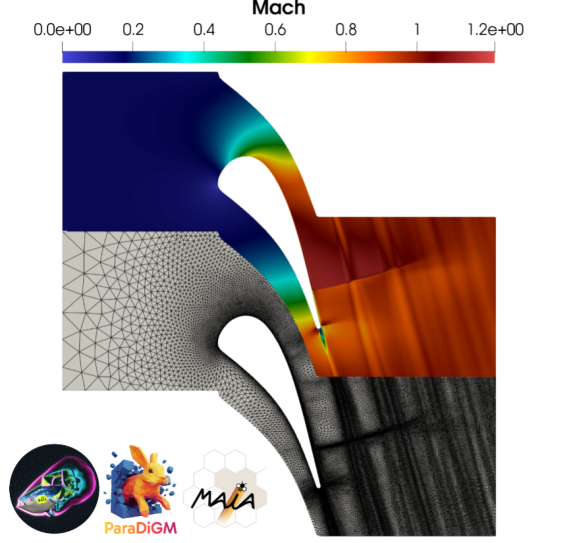
Figure 2. Simulation of the flow around an LS89 turbine blade in periodic configuration. Top: Mach number, bottom: periodic matched mesh.
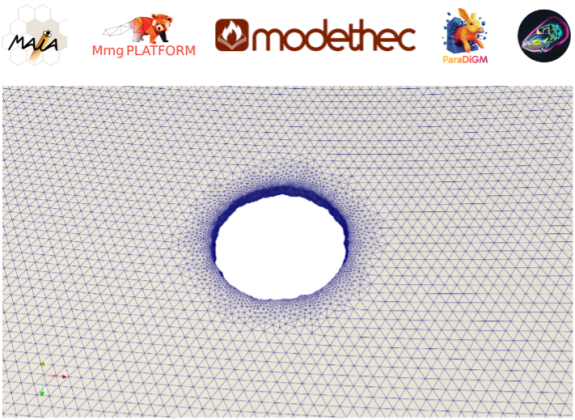
Figure 3. Three-dimensional metal plate piercing simulation with the MoDeTheC solver (ONERA).
More information: https://ecfd.coria-cfd.fr/index.php/Ecfd:ecfd_9th_edition
Home page photo: Figure 1. Coupled simulation with the massively parallel solver YALES2 (CORIA) and MoDeTheC (ONERA), with dynamic mesh adaptation.
.