
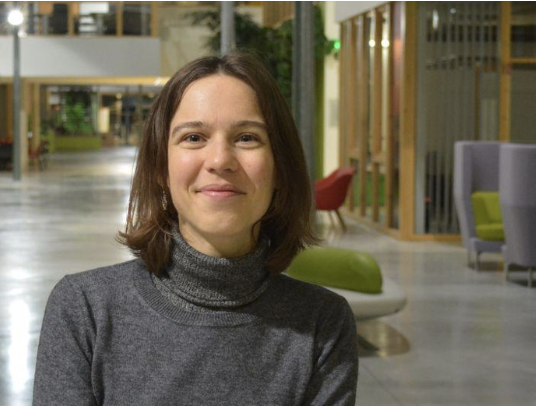
Hello Émilie. First of all, thank you for taking the time to chat. Could you please introduce yourself and tell us about your background
Hello. My name is Émilie Chouzenoux. I'm 36 years old. Breton from Morbihan, I come from Vannes, where I went to high school and a maths preparatory class. In 2004, I entered an engineering school: Centrale Nantes. Today, I'm a Research Associate at Inria Saclay, and have been since 2019. Prior to that, I was Maître de conférences at Université Paris- Est Marne-la-Vallée.
At the heart of my career path is my love of mathematics. I've been drawn to them since childhood. I really enjoy solving problems, to put it that way. After the preparatory school, I was very enthusiastic in engineering school when doctors came to talk about the implications of maths and science in their work. I thought that was brilliant: maths at the service of society! It was a driving force and still is!
Is this what led you to make science your profession?
There's probably something very utopian about the idea of making the world a better place with maths. But it's important to me that my activity has a positive impact on society.
In my final year at school, I chose a specialization, "automatic control and signal processing". Very interested in the use of mathematics applied to medical imaging, I applied for a thesis on optimization algorithms for image reconstruction in a modality called positron emission tomography (PET). Less well-known than MRI, PET is used in research into Alzheimer's disease, but also in the fight against cancer.
The principle is relatively simple. Areas of the brain will light up depending, for example, on the uptake of glucose, which is highly consumed by cancer cells. Sensors translate these phenomena into data, producing a virtual image. By cross-referencing with a scanner image, we can deduce whether something is going well or not...
Today, what is the focus of your research?
First and foremost, I'm not a doctor, but a researcher in engineering sciences. My work involves solving applied mathematical problems in the biomedical field. Starting with the raw data produced by an "imager", the question arises of how to construct the image, given that this operation involves millions of unknowns to be estimated. Complex mathematical models need to be managed and optimized. Among the millions of parameters, we're looking for the optimal choice. This poses advanced theoretical and computational challenges. But we manage in fine to see in pictures what our method produces!
The unit Inria where I work is called OPIS: OPtimisation Imagerie et Santé. So, of course, the medical field is of major interest. One of our flagship applications is to support doctors and radiologists, enabling them to move ever faster and more accurately through the diagnostic and personalized patient follow-up phases. In particular, we are leading several projects in this direction, in partnership with the Institut Gustave Roussy, in the fight against cancer.
What is the contribution of HPC converged with AI in your projects? What role does GENCI play in this?
Artificial intelligence has become an essential part of "computer vision". As a researcher, I want to be a contributor and a source of ideas. In view of the importance of the data involved, the processing power and the support required, our team has decided in the context of the fight against COVID-19 to use the resources of GENCI and the support of IDRIS. The Jean Zay supercomputer and dedicated human support enable work to be carried out in competition with industrial players.
For this AI project applied to lung imaging, we trained models on public health databases to teach the algorithm to recognize the different types of lung lesions that can be encountered in COVID-19 patients from their 3D scanner images. These operations require considerable computing power, but they work! The device enables patients to be better ventilated on arrival at hospital. It is currently in routine use at the Gustave Roussy Institute, which would like to see it deployed more widely. The outstanding results of this project, carried out in partnership with the Kremlin-Bicêtre APHP hospital, the Institut Gustave Roussy and the startup Owkin, have been published in Nature Communication.
Having brought this project to Inria is a great source of pride for me and for our team!
This success contrasts with the description frequently given of a difficulty of access and participation for women in
scientific and technological universes. What are your experiences and thoughts on this point?
In my engineering school graduating class, there were a third of women. But in high school and preparatory classes, I was practically always the only girl in my class, as few female students took the "engineering sciences" option.
There's often a problem with information about these careers, engineering for example. This profession involves difficult, long studies, and for many family support, when possible. Unfortunately, in many families, engineering is still a man's job...
For my part, I think it's vital to offer girls real choices, from an early age. That's also why I take part in actions to present my career path in high schools. I think we need to broaden the range of possibilities from early childhood onwards. I think it's essential to make people want to go.
And then, what I see is that there is often a form of self-censorship. Girls integrate "barriers" in spite of themselves. The reproduction of gender stereotypes certainly has something to do with it. I regularly see young female researchers who prefer their spouse's career to their own, for reasons of mobility in particular. And yet, the fewer women there are in the scientific and technological professions, the less visible we will be...
Finally, when they embark on research, I've noticed that many female PhD students put monumental pressure on themselves. And that's problematic. Perhaps they feel illegitimate? Maybe they feel they have to do more to get ahead?
I've had a lot of help to get over this. I've met "mentors", both men and women, who have guided me and offered me opportunities, throughout my career.
A few words by way of conclusion?
Yes. It seems rather reductive to me to talk only about the place of women. The fight for women's access to and participation in scientific and technological activities could perhaps benefit from being considered more broadly.
First of all, it's French society as a whole that would benefit from opening up more strongly to the sciences. Disseminating scientific culture both at school and in the family sphere will facilitate women's participation in scientific and technological activities and careers.
Finally, I think that in a team, it's diversity understood in the broadest sense that matters: gender, nationality, whatever. This will determine the ability to analyze a problem from so many different angles. Our diversities are essential to move science forward.