
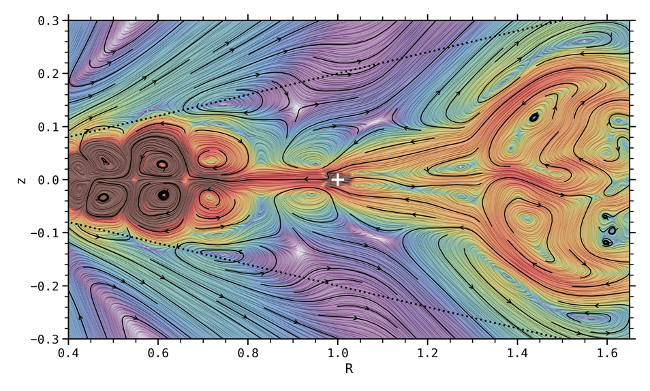
Flow behaviour in the vicinity of a planet three times more massive than Jupiter (in the centre of the image), in a protoplanetary disc with an MHD wind. A flow of greater mass is coloured red.
Composed of gas and dust, protoplanetary disks accompany the first millions of years of the for- mation of young stars, and constitute the primitive phase of planetary systems.
The models of interaction planet-disk are mainly based on hydrodynamic simu- lations where accretion is classically prescribed and originates from a radial turbulent transport of mass into the disk. This accretion scenario has been some years questioned, both theoretically and observationally, by a paradigm that involves the vertical evacuation of kinetic momentum by winds of magnetic origin.
The aim of this project is to study the im- pact of a protoplanet in a fixed circu- olar orbit in a gaseous disk and in the pre sence of a wind (see figure), by means of high-resolution global 3D numerical simulations in non- ideal MHD. To this end, we carried out a set of simulations using the new IDEFIX GPU code developed at the IPAG, by varying the value of the planet's mass and the initial magnetization of the disk.
We find that the massive planets are capable to create in the gas a groove that can become asymmetric, and in which the magnetic field ac- cumulates efficiently.
The result is a rapid accretion flow through the groove that can become sonic for higher magnetizations. The torque due to the wind adjusts to the torque of the planet so as to generate a more intense wind in the outer groove, while the wind is deflected by the planet at level of the inneredge of the groove.
The asymmetry of the groove, both in depth and width, is materialized by progressive erosion of the outer disc, can invert the migration direction of Jovian planets in magnetized disks. For lower-mass planets, we find that the gravitational torque exerted by the gas is stochastic and positive in average, which would translate also by an outward.